|
As a memorial plate at God’s Acre indicates, plots were
allocated there for the Sims family whose property was
close to the cemetery. Remembering them for the pioneers
they were, Shirley Sims has contributed the following
material which is gratefully acknowledged by the
researcher. Appropriately, as will be seen, it precedes
the entry on the Spring family.
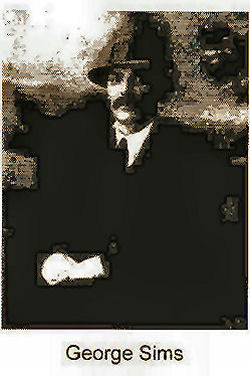
George Sims
(b. 30 April 1879) was the third son of William Sims who
married Mary Ann Marriage on 5 April 1875 at St
Mary’s Church, Spital Square, Spitalfields, Middlesex,
England. Born in Bethnal Green, London, in 1843, Mary
Ann was the daughter of Charles (a packer) and Susanna
(née Matthews) Marriage. Before her wedding she lived in
an institution in the Spitalfields area near Stepney in
London and worked as ‘a visitor of the sick and poor’.
After their marriage William and Mary resided at Norwood
Green, Southall, London where they raised their five
sons: William Jr (b. 1875), Sam (b. 1877), George (b.
1879), Harry and Rob. William Sims Sr was killed on 20
February 1887.
At the time of the 1881 census the record of the Sims
household in Norwood Green (all born in Middlesex) was
as follows: William (34. b. Uxbridge, unemployed general
labourer), Mary A (37, b. London), William C (6, b.
Norwood), Samuel J (4, b. Norwood), George (2, b.
Norwood), and Jean Watts (22, b. Paddington, visitor,
nurse and domestic).
George Sims
married Catherine Kate Spring, the sister of Tom
William Spring, at Hillingdon, Middlesex, the bride’s
birthplace, in 1900. Catherine was the seventh child of
James and Emma (née Mason) Spring and the grand-daughter
of William (an agricultural labourer) and Elizabeth
Spring. More about her family background may be read in
the Spring entry which follows.
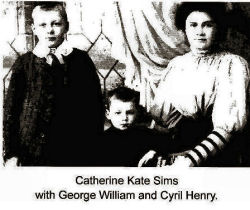
Three children were born to George and Catherine while
they were living in England: Catherine Kate (b. 20
January 1901; d. six weeks later), George William (b. 24
December 1902) and Cyril Henry (b. 30 January 1908).
Intent on finding a better place for their families to
live, George Sims and his brother-in-law Tom William
Spring travelled to Australia via Teneriffe and Cape
Town on the 11,000-ton RMS Ruahine (Captain F
Forbes). The ship left the Royal Albert Docks (London)
on Friday, 9 June, and, after embarking passengers at
Tilbury, proceeded to Plymouth where more passengers and
mail were taken on board. As well as recording the
arrival of the vessel in Hobart on 20 July, the local
newspaper, the Mercury, includes a passenger list
in which the names TW Spring and G Sims, both bound for
Brisbane, appear.
Four days later our two travellers boarded a ship for
Sydney. One can deduce from shipping records that this
was almost certainly the 2,700-ton Palooma
(Captain Livingstone) which reached Sydney on 26
July. The final leg of the journey to Brisbane was made
on the 2,200-ton Peregrine (Captain WTC Firth)
which reached its destination on 31 July 1911.
As far as is known, George and Tom obtained board and
lodging there at a boarding house owned by Mrs Hayes,
Stanley Street, opposite East Brisbane State School.
From here they found work as labourers digging trenches
for pipelines around Brisbane. They later moved to a
property known as Barlow’s farm at Ipswich Road,
Rocklea, before nominating their families for travel to
Australia.
George Sims’s wife Catherine Kate and their two sons,
George William (9) and Cyril Henry (3), together with
Tom Spring’s wife Annie and their three young
sons—Charles (9), Cyril (6) and Alexander (3)—sailed
from London as nominated passengers on the Rippingham
Grange (Captain A Lay) on 17 January 1912. The
ship reached Moreton Bay on 14 March 1912 and berthed in
Brisbane on the following day.
Two more children were born after Catherine’s arrival in
Australia—Stephen James on 10 December 1916 and Edith
Nellie on 4 April 1921.
After living at Barlow Farm for some time, the two
families purchased properties on Kerry Road near
Archerfield Aerodrome. There they separately engaged in
dairy farming. The younger members of the Sims and
Spring families delivered milk on horseback before going
to school. Some of their regular customers were living
at South Brisbane. The children completed their
education at the Cooper’s Plains State School.
The return shopping trip to Brisbane by horse and sulky
for food supplies, probably once a fortnight, was a full
day’s journey. On one of these trips George Sims left
home for the normal shopping expedition and on the way
home the horse shied and George was thrown from the
sulky and injured his right arm. It later became
infected, resulting in the arm’s being amputated to the
elbow. This unfortunate accident put a strain on the
family’s normal dairying activities; and George obtained
work as a nightwatchman at Archerfield Aerodrome.
It was at this time that the families became involved
with ‘God’s Little Acre’, the cemetery at Archerfield
Aerodrome and continue to retain an interest in this
sacred area.
During the early stages of World War Two the properties
owned by the Sims and Spring families were purchased by
the Commonwealth Works Department for use at the
aerodrome for war service activities. Subsequently, the
family home of George and Catherine Sims was moved from
Kerry Road to a site on Beaudesert Road, Cooper’s
Plains, where they lived until just prior to their
respective deaths.
George Sims passed away at the home of his daughter
(Edith Toy) at Dora Street, Moorooka, on 19 September
1948; and Catherine passed away in the Brisbane Hospital
on 6 December 1953. Both burials took place in the South
Brisbane Cemetery (4 470).
George Jr continued in the dairying industry. Cyril
established himself in the earthmoving and trucking
industry, now still operated by his four sons and one
daughter. Stephen was involved at Archerfield Aerodrome
as an aircraft engineer; and Edith worked at the
aerodrome until her marriage to Ron Toy, also an
earthmoving contractor. All of the family of George and
Catherine have since passed on.
|