|
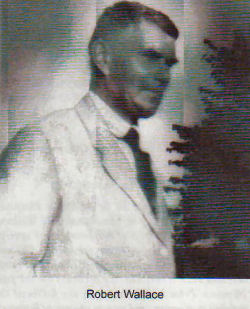
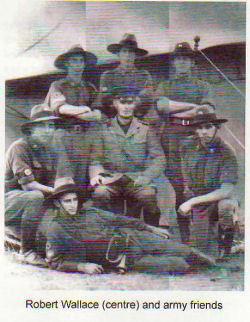
Robert Wallace
was born on 21 September 1876 at 7 Ibrox Place,
Govan, Scotland, to the Reverend James and Christina
(née MacFarlane) Wallace. His father was the Church
of Scotland minister of the first Plantation Church
in Paisley. James and Christina were married on 30
November 1875 in Kelvin, Glasgow, Lanarkshire.
Having graduated as a doctor (MD, ChB) from the
Glasgow University, Robert emigrated to Australia.
He was registered as a legally qualified medical
practitioner by the Queensland Medical Board on 2
July 1908 and worked for a time in North Queensland.
It was at the Cairns Hospital that he met his future
wife, Sarah Lily Grenier, the matron of the
hospital.
Lily (as she was known), the beautiful daughter of
George Alexander and Sarah Mary Agnes (née
Greenwood) Grenier, was born on the family farm at
Cooper’s Plains on 22 November 1873. Her paternal
grandparents were Thomas and Mary (née Pannell)
Grenier—both of whom (as well as her parents) are
buried in God’s Acre; and her maternal grandparents
were James and Mary (née Canavan) Greenwood. Details
of her brothers and sisters and other family members
can be found under appropriate headings elsewhere in
these pages.

Lily’s ambition to train as a nurse did not meet
with the immediate approval of her parents; but they
were won over by her brother Ernest who assured them
that it was ‘a respectable occupation for a lady’.
Robert and Lily were married in Cairns on 26 August
1909. The first of their two children, Robert Jr
(Bob) was born on 21 May 1911 in ‘St Elmo’, Nurse
Woods’s Private Hospital, Stephens Road, South
Brisbane. Their daughter Mary was born on 19 March
1913 after the family had moved to Rosewood—a town
about 28 miles from Brisbane where Robert
established a thriving medical practice
Margaret Scott, the daughter of Dr Robert Wallace Jr,
takes up the story of her paternal grandparents at
this point:
Both Robert and Lily encouraged their children to be
involved in what Mary called ‘Australian
activities’—such as horse-riding and swimming and
diving in the nearby dam. Lily took both children to
a dancing class; and because they both ‘danced like
elephants’ discontinued the lessons. Travelling in a
horse and sulky, they visited friends and the
Grenier relatives, including Ern and Daisy Grenier.
Interestingly, both Bob and Mary thought that their
father was ‘very Australian’. He chose Banjo
Paterson’s poems as the first piece of literature to
read to them, and he was especially fond of ‘The Man
from Snowy River’. Over the years Robert encouraged
Bob and Mary to read widely, including some of the
books he’d brought to Australia and which he’d read
while travelling as a ship’s doctor around the west
coast and islands of Scotland. In their bookcase
stood classical novels, accounts of World War One,
books by Rudyard Kipling and Flynn’s writings about
the Australian outback.
Bob grew cotton for his pocket money when he was
eleven. One day a letter arrived from the Queensland
Cotton Board addressed to Robert Wallace, requesting
his presence at a meeting of cotton-growers in
Brisbane. Smiling, Robert told Bob to go to this
meeting; and there was much mirth when Bob told his
family how surprised the other cotton-growers were
to see this young boy, dressed in short pants, at
this meeting.
Robert was busy attending to patients in his
surgery, sometimes assisted by Lily, and in the
early days riding a horse to visit his patients. He
kept several horses so that he always had one ready
to visit a patient. Later he travelled by car. It
seems that Robert was a caring doctor. Many years
later when Mary visited Rosewood several people told
her that her father ‘did more than treat their
illnesses’. They said that he waived fees for the
poorer patients and took people to hospital in his
car.
Unfortunately, Robert was out delivering a baby when
Mary was born and he did not see her until many
hours later. Of course, he felt very disappointed at
not being there. However, there were some happy
times associated with being in a medical practice.
After treating a performer from Wirth’s Circus,
Robert was given free tickets for the family to go
to the circus; and many patients showed their
appreciation by giving family members presents.
Sadly, Lily died on 19 September 1928 after
suffering from cancer of the bowel for approximately
six weeks. Bob, who was seventeen years old,
travelled home by train from his boarding-school;
and when he reached the Rosewood railway station he
saw that most of the people of the town had gathered
there to meet him. Mary, fifteen years old, also
returned from her boarding school. Lily’s funeral
was held on 21 September 1928—Robert’s birthday. The
weather that day was extremely hot and humid, with
heavy rain falling.
Lonely and grieving after Lily’s death, Robert
devoted himself to his patients and caring for Bob
and Mary; and consequently he became quite wealthy.
He wanted to spend his money on his children, and
one day asked Bob if he would like a car to travel
to and from Melbourne University where he was
studying medicine. Bob surprised him by saying,
‘Thank you for the offer, but I don’t want a car
because I prefer to travel on the train’.
Robert read the letters Mary wrote to him from
boarding-school and then he corrected her spelling
errors with a red pen. When Mary told me about this,
I asked her if she was upset; and she replied, ‘No,
I felt grateful to my father for caring enough to
point out my mistakes’.
Lily Wallace’s remains were laid to rest in God’s
Acre two days after her death. The following people
had official roles: James P Reed (undertaker), the
Reverend Alfred W Gilbert (Church of England
minister), and J Dibble and A Thompson (witnesses).
This obituary appeared in the
Queensland Times
after Lily’s death:
ROSEWOOD, September 22
The death took place at St Andrew’s Hospital,
Ipswich on Thursday of Mrs. Sarah Lily Wallace, wife
of Dr. R. Wallace of Rosewood. For several weeks
Mrs. Wallace had been seriously ill. She was a
member of the Grenier family, of Cooper’s Plains,
and had been a resident of Rosewood for the past 16
years. Prior to her marriage she followed the
nursing profession, and was in charge of hospitals
at Mt. Garnet and other northern towns. Besides her
husband she leaves two children, Mary and Robert,
both of whom are attending colleges. Her sister,
Mrs. D. S. Cameron and four brothers, Messrs.
Reginald, James, William and Ernest Grenier survive
her. The funeral left from Ipswich yesterday for the
Cooper’s Plains Cemetery. It was attended by a
number of Rosewood residents. Rev. A. W. Gilbert of
St. Luke’s Church of England officiated at the
graveside.
During Lily’s illness (and for about three years
after that) her elder sister, Mary May Cameron, kept
house for Robert at John Street, Rosewood. He
survived his wife by less than a decade and passed
away at his residence on 2 November 1936 aged 60
years and 1 month. His cremation took place at the
Mount Thompson Crematorium on the following day
after a service in St Luke’s Church of England,
Rosewood. Later his ashes were placed in a suitably
inscribed marble urn on Lily’s grave. An obituary in
the
Queensland Times
remarks: ‘He was of kind and considerate nature, and
all sections of the community deeply regret his
death’.
Robert was not the only member of his family to
emigrate to Australia. His brother Thomas Irby
Wallace MB, ChB (Glasgow), who died at his home in
Camp Hill, Brisbane, on 8 July 1961, had a medical
practice in Longreach at the time of Robert’s death.
Earlier on 16 March 1911, while Medical Officer at
the Mount Perry Hospital, he had been called on to
give evidence at a Royal Commission to inquire into
the health conditions in Queensland mines. Another
brother, James, passed away in Brisbane on 17 March
1913. Robert was also survived by his sisters in
Scotland, Dr Edith Burley and Miss Ethel Wallace.
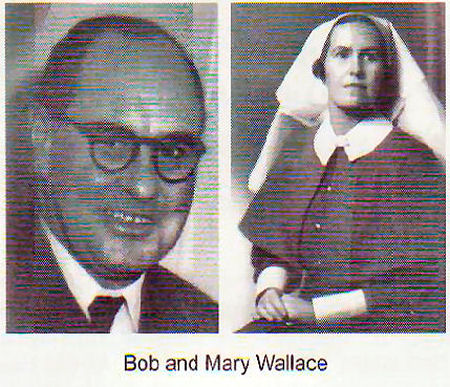
Following in his father’s footsteps, Robert
Wallace Jr studied medicine and practised as a
doctor in Rosewood where he took over his father’s
practice (1936-39) and in Victoria (1941-1980). He
and his wife Theodora Eleanor Hooks, whom he
married on 3 April 1937, raised one daughter and
three sons. Bob passed away on 19 June 1994.
Mary Wallace
trained as a nurse at St Martin’s Hospital,
Brisbane, and during World War Two joined the Royal
Australian Nursing Service on 3 May 1940. As Captain
Wallace she served in New Guinea and further afield
until she was discharged on 5 November 1946, at
which time she was attached to 2/2 Australian
General Hospital. Mary’s courageous devotion to duty
and her ‘distinguished services in the South-west
Pacific area’ were recognised when she was
officially mentioned in despatches.
|