|
The researcher is indebted to Mrs Jean Kilpatrick, the
grand-daughter of Mary Cecilia Foote
Williams, for her reminiscences of the family’s early
history.
The Williams family of special interest to readers of
these pages was living on Urgles Farm in the small
village of Meavy in the English county of Devon at the
time of the 1881 English census. Their household was
composed as follows: William (44, b. Walkhampton, Devon,
farmer of 36 acres), Cecilia (52, b. Meavy, farmer’s
wife), James Richard (20, farmer’s son), John Thomas
(18, farm labourer), Arthur (14), Richard Jonas (11),
Mark Northmore (11) and Mary Cecilia (7). All of the
children were born in Meavy with the exception of Arthur
and Richard Jonas whose birthplace is given as Stoke
Damerel, Devon.
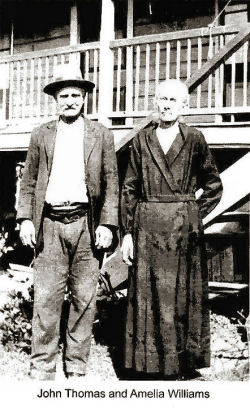
John Thomas Williams,
one of the seven children of William and Cecilia Foote
(née Northmore) Williams, emigrated to Australia from
Plymouth, Devonshire. He arrived in Brisbane on 8
February 1885 on board the 2,500-ton schooner-rigged
steamer
New Guinea
(Captain TR Mowat Jr), one of 244 immigrants. The
vessel, launched only a few months, left Gravesend
(London) on the morning of 5 December 1884, travelled
via the Suez Canal and, after calling at Thursday
Island, Cleveland Bay (Townsville) and Keppel Bay (near
Rockhampton), was finally brought up the Brisbane River
by the tug
Otter on the afternoon of
8 February 1885 to the DL Brown and Company Wharf.
Heading west from Brisbane, John Thomas settled in the
fertile Lockyer Valley where he sought employment as a
farmer. While there he met Amelia Avis whose
parents farmed a property at Ma Ma Creek about 5 km.
from Gatton. They were married in Gatton on 13 November
1889 and became the parents of: Mary Cecilia Foote (b. 3
March 1890), Martha Amelia (b. 28 May 1891), William
Henry (b. 7 November 1893), Florence Anna (b. 9 March
1896), Alice Winifred (b. 20 February 1898), and
Percival John Thomas (b. 23 September 1900).
Sadly, Percival John Thomas Williams died from
whooping cough aged but two months on 22 November 1900,
his mother’s birthday. His remains were interred in the
Cooper’s Plains Cemetery on the same day. The Reverend
John Stewart Pollock, the rector of the Sherwood (Oxley)
Presbyterian Church, presided; and the two witnesses to
the burial were John T Williams and Joseph Avis
(probably the boy’s maternal grandfather).
By that time the family had long since established
themselves in Rocklea on the south side of Brisbane in a
house which backed onto the railway line behind the
station. John continued his farming activities on a
nearby property along Oxley Creek. However, he retained
his links with Gatton; and it was there at the fifth
annual ploughing match, held under the auspices of the
Lockyer Agricultural and Horticultural Society on 29
August 1901, that he was awarded an inscribed gold medal
which he wore proudly on his fob chain.
As their children, all of whom had attended the Rocklea
State School, grew up and left home, John and Amelia
acquired a small house next door to the Tuckett family.
Two members of this family lie buried in the Cooper’s
Plains Cemetery—Harry (d. 25 August 1936) and his wife
Annie (d. 5 July 1945).
Eventually, John and Amelia moved to a corner property
in Muriel Avenue, Rocklea, where they lived out their
days in a large Queenslander with a verandah on three
sides. There was a stable for Dolly the horse and an
ample market garden for John to tend. An enterprising
man, John augmented the family farming income by mowing
the grass on the Yeerongpilly Golf Links.
At this point it would be well to record some details of
Amelia’s background. Her parents, Joseph Avis and
Rachel Willingham, were married in the Church of St
Andrew-by-the-Wardrobe in Queen Victoria Street, London,
on 15 April 1867. Close to Blackfriars Theatre, St
Andrew’s was Christopher Wren’s last city church. It has
associations with William Shakespeare who bought a house
in Ireland Yard in this parish
Joseph and Rachel came to Australia on the Black Ball
Line’s 766-ton
Young Australia
(Captain DR Bolt) which left Gravesend on the afternoon
of 12 April 1869 and dropped anchor in Moreton Bay on 13
July 1869, having travelled around the Cape of Good Hope
and the southern tip of Tasmania.
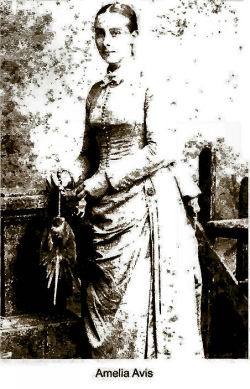
Amelia Avis was born in Gatton on 22 November 1869. The
Queensland Post Office Directory for 1874 lists a J Avis,
squatter, Lockyer’s Creek, Gatton. Her brothers and
sisters were: Elizabeth (b. 1868; d. 1 July 1869 towards
the end of the voyage from England), Mary Ann (b. 27
June 1871; m. William Kennedy 5 January 1895), Emma (b.
17 December 1873; d. 29 December 1893), Joseph Jr (b. 20
June 1876; m. Ellen Louisa Francis 3 January 1900; d. 14
July 1956), John (b. 24 September 1878; d. 4 April
1962), Eliza (b. 3 August 1880; d. 18 October 1882),
Rachel (b. 4 May 1883; m. Jack Naginasingh 19 August
1903; d. 23 June 1964), Florence (known as Florrie, b. 1
August 1885; m. George Cook (date?); d. 30 March 1959),
and Louisa (b. 5 October 1886; m. Frederick Henry
Bourbon 21 February 1920; d. 10 July 1965).
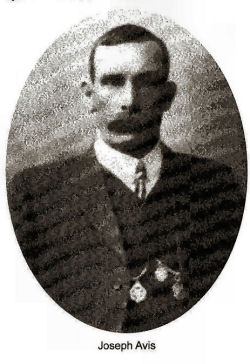
Joseph Avis, farmer and postmaster, passed away on18
January aged 79 and was laid to rest in the Anglican
Cemetery Ma Ma Creek. His wife Rachel, the daughter of
John and Ann Willingham, died at her home after a long
illness on 18 September 1927 aged 81. Her burial service
at the graveside in the Anglican Cemetery at Ma Ma Creek
was conducted by the Reverend JD Anderson.
Amelia Williams passed away on 31 July 1938. Her funeral
left from the family residence, Muriel Avenue, Rocklea,
on the following day for the Mount Gravatt Cemetery
(monumental section 4E 8 611). John Thomas Williams died
on New Year’s Day 1942; and his remains were interred
beside those of his wife on 2 January 1942. In both
cases the funeral directors were Cannon and Cripps.
|